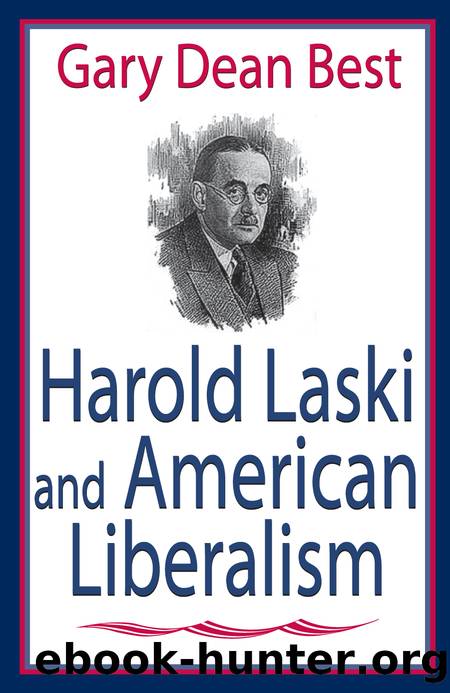
Harold Laski and American Liberalism by Gary Best
Author:Gary Best [Best, Gary]
Language: eng
Format: epub
Tags: United States, Biography & Autobiography, 20th Century, Political Science, Asia, History, Political, General
ISBN: 9780765802668
Google: t6cUnwEACAAJ
Goodreads: 289486
Publisher: Routledge
Published: 2004-11-30T00:00:00+00:00
6
The Road to War
Evidence that American college students showed little interest in âEuropeâs war,â led Laski to dash off The Strategy Of Freedom: An Open Letter To American Youth in the summer of 1941. Laskiâs biographers observe that âLaski knew full well that he was also writing for Roosevelt, if not to convince him, then certainly to help to generate support for more interventionist policies.â âMen,â Laski wrote, âare either for or against the Nazi tyranny, and if they declare their indifference to it they are already its allies.ââ1 A reviewer in Survey wrote that Laski,
aware of the fact that there exists in the United States a new type of anti-British sentiment, a feeling which has perhaps done more to retard our efforts toward defeating Herr Hitler than any other single factor, speaks directly and frankly to American youth. He speaks as a socialist, as an influential member of the British Labour Party and as an Englishman who knows the United States and its institutions better, so I believe, than any other living Englishman. He pleads with American youth to believe in the British cause and to see it as their cause as well.2
Laski had by now become simultaneously an asset and a liability to the British war effort. His eloquent defense of the war made him an asset both for British efforts to rally support in the United States and for American advocates of increased aid for the allies, if not intervention, but his attempts to âradicalizeâ the war had the effect of negating much of his value. Thus, the British government was wary of turning Laski loose in the United States, and was careful to watch over the content of his broadcasts beamed there. As Laski summed up the dilemma for Frankfurter in July, 1941: âIt is curious that every time it is suggested that I broadcast to America the Board of Control in the B.B.C. begins to show signs of fear; and about every week the M[inistry]. of I[nformation] comes round to ask how they can tackle this or that American problem.â Laski, however, continued to write a weekly cable that was published in American newspapers. 3 Frankfurter read it in the Washington Post, found it âcontinuously good,â and wished âit were more widely published.â4
Laski had the comfort of John Winantâs presence as Kennedyâs successor, after Laski had recommended him to Roosevelt for the post. In April, 1941, Laski wrote Frankfurter that Winant was winning âgolden opinions on every score, and, above all for his simplicity and directness.â Ben Cohen had also been sent by FDR to the American embassy in London to aid in refugee matters, and Laski wrote that he tried âto drop in on Ben every so often,â but he was ânot quite sure that he is not a little embarrassed by my evil reputation here; at any rate he does not leave me with the impression of wanting or giving confidence.â5
Laskiâs oft-expressed radical view of the war and its consequences for him was expressed in a letter to Frankfurter in August.
Download
This site does not store any files on its server. We only index and link to content provided by other sites. Please contact the content providers to delete copyright contents if any and email us, we'll remove relevant links or contents immediately.
| Anthropology | Archaeology |
| Philosophy | Politics & Government |
| Social Sciences | Sociology |
| Women's Studies |
The Secret History by Donna Tartt(19088)
The Social Justice Warrior Handbook by Lisa De Pasquale(12190)
Thirteen Reasons Why by Jay Asher(8909)
This Is How You Lose Her by Junot Diaz(6887)
Weapons of Math Destruction by Cathy O'Neil(6279)
Zero to One by Peter Thiel(5802)
Beartown by Fredrik Backman(5754)
The Myth of the Strong Leader by Archie Brown(5507)
The Fire Next Time by James Baldwin(5444)
How Democracies Die by Steven Levitsky & Daniel Ziblatt(5218)
Promise Me, Dad by Joe Biden(5153)
Stone's Rules by Roger Stone(5088)
A Higher Loyalty: Truth, Lies, and Leadership by James Comey(4963)
100 Deadly Skills by Clint Emerson(4925)
Rise and Kill First by Ronen Bergman(4789)
Secrecy World by Jake Bernstein(4753)
The David Icke Guide to the Global Conspiracy (and how to end it) by David Icke(4718)
The Farm by Tom Rob Smith(4509)
The Doomsday Machine by Daniel Ellsberg(4490)
